Older Than Life Itself: The Astounding Ages of Natural Gemstones
The diamond in an engagement ring may be older than every fossil ever found. Older than the first single-celled life. Older than the oxygen in the air you are breathing right now. Not metaphorically. Literally.
This is the part of the gemstone story that rarely gets told. We talk about colour, clarity, rarity, and price, and we skip past the most astonishing fact of all: natural gemstones are among the oldest objects a human being will ever touch. This article is a tour through the deep time hiding in plain sight in a jewellery case, grounded in current geological research. Fair warning: the numbers are genuinely hard to comprehend.
How old is old? A quick calibration.
To appreciate gemstone ages, some reference points help. Earth itself is 4.54 billion years old. The first single-celled life appeared around 3.5 billion years ago. The Cambrian Explosion, when complex life suddenly diversified in the fossil record, happened 541 million years ago. The dinosaurs went extinct 65 million years ago. Modern humans appeared roughly 300,000 years ago, and recorded human history spans about 5,000 years of those numbers. They are about to make everything else in this article sound impossible.
How old are diamonds?
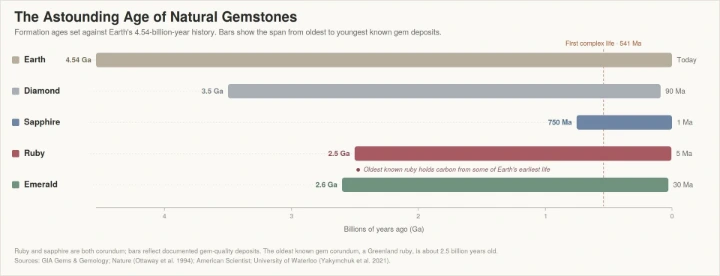
Natural diamonds range in age from around 90 million years to 3.5 billion years old. The oldest dated examples come from the Diavik and Ekati mines in northern Canada, at 3.3 to 3.5 billion years old, according to research published in GIA's journal Gems & Gemology. For perspective, that is roughly three-quarters of the age of the planet itself.
Diamonds form 150 to 200 kilometres below the Earth's surface, in the upper mantle, at temperatures between 900 and 1,300°C and pressures around 50,000 times what you are experiencing at sea level. Growth is extraordinarily slow. Diamond crystals build up layer by atomic layer, and after forming, many diamonds sit dormant in the mantle for hundreds of millions or even billions of years before a kimberlite eruption carries them violently to the surface. The three-billion-year-old diamonds recovered from South Africa's Kimberley mines lay waiting underground for most of the history of the planet before surfacing in eruptions a mere 145 to 66 million years ago.
The Smithsonian Institution's diamond curator Jeffrey Post has noted that the famous Hope Diamond is at least a billion years old, and probably considerably older. And some blue diamonds carry an even stranger story: they contain trace elements from ancient oceanic crust that was dragged down into the mantle by plate tectonics, meaning the stone in a blue diamond ring holds chemical evidence of oceans that vanished from the planet's surface billions of years ago.
Here is the sentence worth pausing on. Most natural diamonds predate the Cambrian Explosion, which means most natural diamonds are older than every fossil that has ever been found. When the first trilobite crawled across an ancient seafloor, the diamond on your finger had already existed for two billion years.
How old are rubies and sapphires?
Rubies and sapphires, both varieties of the mineral corundum, span an age range from about one million years to 2.5 billion years old. Their formation clusters around three great geological events, which means the age of a sapphire or ruby depends heavily on where it came from.
The oldest known rubies come from Greenland and date to approximately 2.5 billion years old. In 2021, a research team at the University of Waterloo led by Professor Chris Yakymchuk made a discovery inside one of these ancient stones that borders on poetic: graphite, pure carbon, that analysis indicates is the residue of some of Earth's earliest life (Yakymchuk et al., Ore Geology Reviews, 2021). The ruby formed around the remnants of the planet's first biosphere. It does not merely predate complex life. It physically contains a trace of the earliest life we know of.
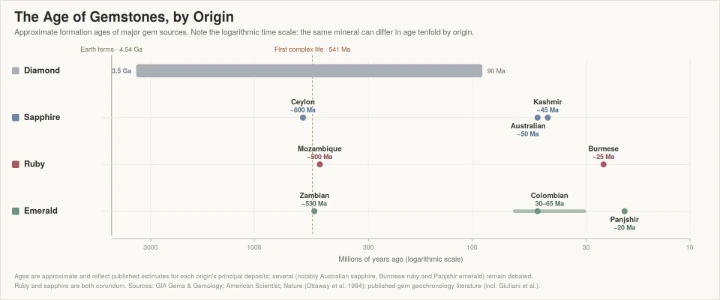
For the stones in commercial circulation, research summarised in American Scientist identifies three main corundum-forming epochs. The Pan-African orogeny, 750 to 450 million years ago, produced the primary deposits of Africa, India, Madagascar, and Sri Lanka. The Himalayan orogeny, 45 to 5 million years ago, produced the marble-hosted ruby deposits of Myanmar, Afghanistan, Pakistan, Nepal, and Vietnam. And Cenozoic basalt eruptions, 65 to 1 million years ago, produced the basalt-associated sapphires of Australia, Thailand, and southern Vietnam.
That middle event deserves a moment. The Himalayan orogeny is the collision of the Indian tectonic plate with Asia, the same slow-motion impact that raised the Himalayas and pushed Mount Everest towards the sky. Fossilised sea creatures have been found in the limestone near Everest's summit, lifted from an ancient seafloor by the sheer violence of that collision. Burmese rubies and Kashmir sapphires were forged in that same event. Every fine Mogok ruby is a small souvenir of the crash that built the world's highest mountains.
Ceylon sapphires, on the other hand, belong to the much older Pan-African event. A Sri Lankan sapphire of around 600 million years old formed at roughly the moment the first complex multicellular animals were evolving. Someone wearing a Ceylon sapphire is wearing a stone that is older than animals.
How old are emeralds?
Emeralds span a wider age range than perhaps any other precious stone: from around 30 million years old for the youngest Colombian material to nearly 2.6 billion years old for emeralds from the Sandawana deposit in Zimbabwe.
Emeralds are geologically improbable objects. They require beryllium, an element that concentrates in continental crust, to meet chromium, an element abundant in oceanic and mantle rocks. These two elements have no business finding each other, and the rarity of emerald reflects how seldom they do.
Colombian emeralds, from the legendary mines of Muzo, Chivor, and Coscuez, are between roughly 30 and 67 million years old. Their formation, described in a landmark 1994 paper in Nature (Ottaway et al.), is unique on the planet: hydrothermal brines heated by tectonic activity moved through organic-rich black shales, liberating trapped chromium, vanadium, and beryllium and precipitating emerald crystals in veins. No other emerald deposit on Earth formed this way, which is part of why Colombian stones look like nothing else.
And Colombia offers one of the strangest facts in all of gemmology. In the emerald-bearing shales, a small number of gastropod fossils have had their shells replaced by emerald, as reported in Rock & Gem Magazine. A fossilised sea snail, its shell transformed into precious gem material. The boundary between palaeontology and gemmology, dissolved in a single object.
Zambian emeralds tell a different story across a vastly longer timeline. The chromium in Zambia's Kafubu emerald fields comes from komatiite lava flows around 1.6 billion years old, lavas so hot they cannot physically erupt on the modern, cooler Earth. The beryllium arrived much later, in pegmatite intrusions around 530 million years ago during the Pan-African orogeny, and the emeralds grew where the two met. A Zambian emerald is a collaboration between two geological eras separated by more than a billion years.
The Sandawana emeralds of Zimbabwe are the elders of the entire coloured stone world at 1.9 to 2.6 billion years old. An emerald from this deposit can be more than half the age of the planet.
How do scientists actually know how old a gemstone is?
Gemstones generally cannot be dated directly. The trick, as explained in GIA's Gems & Gemology (Spring 2019), is to date the tiny mineral inclusions trapped inside them, which formed at the same time as the host crystal and act as microscopic time capsules.
Carbon dating, the method most people have heard of, is completely useless here. Carbon-14 has a half-life of just 5,700 years, so it decays to nothing long before you reach even the most recent gem-forming events. Instead, geochronologists use radiometric systems with half-lives measured in billions of years: uranium-lead, samarium-neodymium, rubidium-strontium, and argon-argon dating, applied to inclusions of minerals like garnet, muscovite, and sulphides inside the stones.
There is a nice symmetry in this. The inclusions that allow a laboratory to identify a stone's geographic origin are the same features that allow scientists to read its age. Every inclusion in a natural gemstone is a message from deep time, chemically legible to those who know how to read it.
What were these stones around for?
Numbers this large resist comprehension, so here is what some of these stones have actually existed through.
A 3 billion year old diamond existed before the atmosphere contained oxygen. It was already ancient when the first single-celled life appeared, and it sat quietly in the mantle, 150 kilometres beneath the surface, while the entire history of life unfolded above it.
A 2.5 billion year old Greenland ruby contains carbon that was once alive. The stone did not just witness the planet's first biosphere. It preserved a piece of it.
A 600 million year old Ceylon sapphire formed as the first complex animals were emerging. Trilobites, the first fish, the first creatures to crawl onto land: all of them came after the stone.
A 65 million year old Colombian emerald is roughly the age of the asteroid impact that ended the dinosaurs. When Chicxulub struck, the emerald was already resting in the Andean shales, where it would wait another 65 million years for a conquistador to hear rumours of green stones in the mountains.
A 45 million year old Burmese ruby was forged in the collision that raised the Himalayas, younger than the extinction of the dinosaurs but vastly older than anything resembling a human being.
Does a gemstone's age affect its value?
Directly, no. Gemstones are not priced by age. Few lab reports carry a line for millions of years, and the market determines value through colour, clarity, cut, carat weight, origin, and treatment status, exactly as our articles on gemstone treatments and lab reports describe.
But age matters for something that sits underneath price: meaning. A natural gemstone is a physical object with a lineage that dwarfs anything else in human experience. It existed before humans, before civilisation, before language, in most cases before complex life itself. It will still exist long after everything familiar has passed. A laboratory can replicate a gemstone's chemistry in a matter of weeks, and we have written elsewhere about what that does and does not mean. What no laboratory can replicate is time. Three billion years cannot be manufactured, marketed, or grown in a crucible. It can only be inherited from the planet itself.
That, more than anything else, is what someone holds when they hold a natural stone.
If you are a retailer or designer and would like to bring some of this deep-time story into your own client conversations, or you simply want to talk about the stones themselves, we are always happy to share what we know. The science makes the stones more remarkable, not less, and it deserves to be part of how the trade talks about them.